By Vivian Morelli
Reporting from Tokyo
Feb. 12, 2026
Some of the most useful gifts are the ones that people need every day. Or even better, help to start their day.
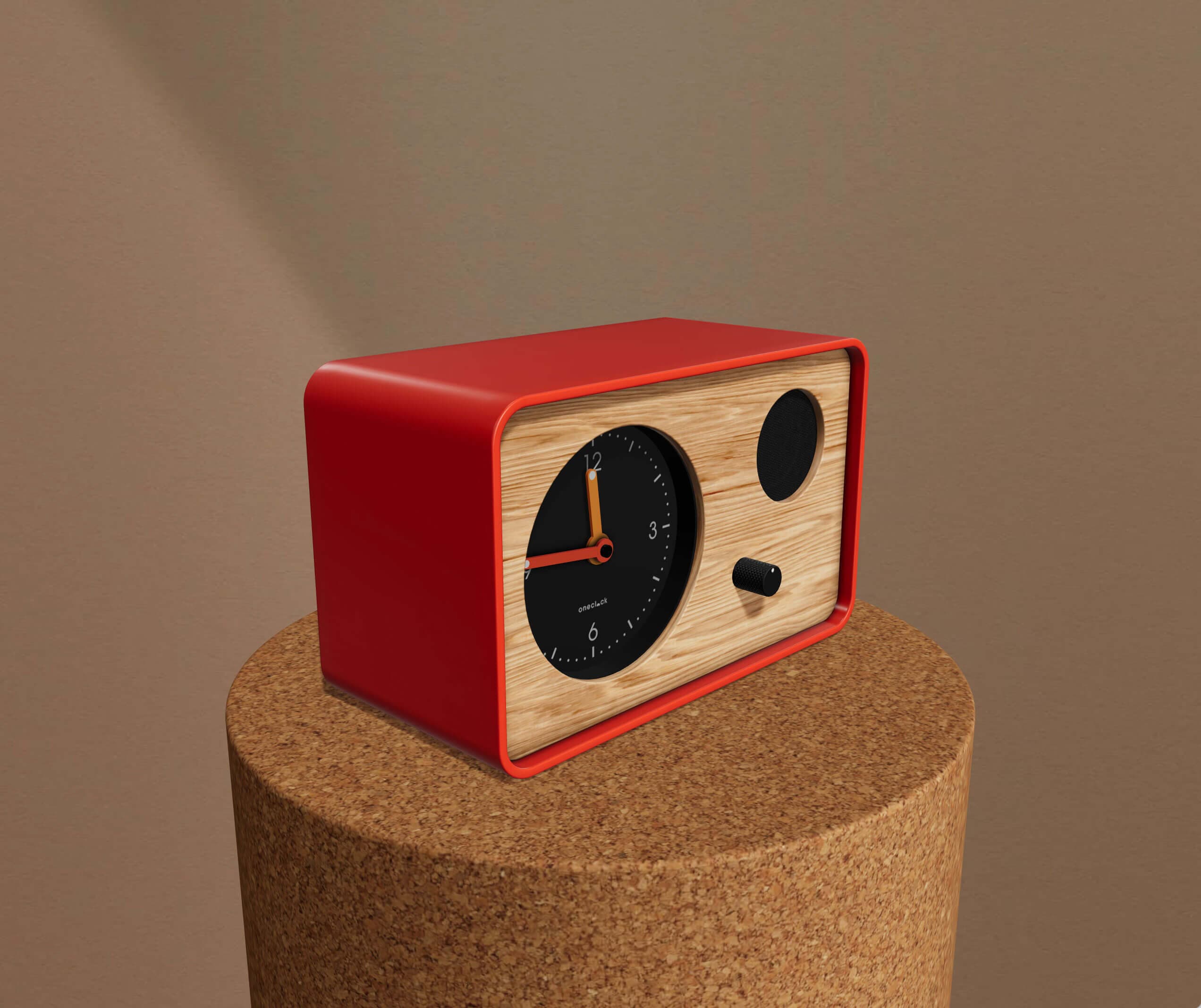
This particular one begins with melodies — composed by Jon Natchez, a member of the Philadelphia indie rock band War on Drugs — to gently pull a person out of sleep. They play from an analog timepiece called OneClock, designed by Jamie Kripke, an artist who lives and works in Boulder, Colo.
The idea, Mr. Kripke said during an interview at a cafe in Tokyo, where he was visiting on a combination of vacation and business, was to make something that “is not going to wake you up by scaring you awake. It just taps you on the shoulder and then brings you out of sleep very gradually.”
The clock, he said, was born out of a simple effort to encourage “better sleep by getting the phone out of the bedroom” and better mornings through a beautiful waking experience.
As Dr. Alanna Hare, the co-president of the British Sleep Society, wrote in an email: “Screen use, particularly around bedtime, has consistently been shown to be associated with delayed sleep times and thus reduced opportunity for sleep as well as with reduced sleep quality and poorer daytime functioning across the life span.”
OneClock users have said the device is effective. One buyer wrote on the website that waking up with OneClock was “peaceful … nice not to have the cell at the bedside!”
About five years ago, Mr. Kripke and his wife, Kate Kripke, decided they wanted their phones out of their bedroom, but knew they needed something to wake them. “I just could not find anything I liked,” he said. “You can buy some beautifully designed clocks, but then they have this cheap little ding ding ding, just like digital beeps.”
So he designed his own: a desktop model with a sleek aluminum case that is 7.1 inches wide and 4.4 inches high and a white oak face punctuated only by the dial, a speaker and what is called the Waking Knob, a single peg-like protrusion used to set the alarm. Mr. Kripke said the clock mechanism was designed in Switzerland by a company that manufactures gauges for luxury auto brands and is produced in China, but he declined to identify either company.
The clock is powered through a USB-C cord and ships with a two-prong USB-C adapter for use in the United States. Now offered in white or black (the red case sold out), OneClock is $349 and sold through its online site.
The design, Mr. Kripke said, reflects the golden ratio, a classic proportion used to create visual balance that can be found in nature (such as honeybees) and in human creations (including the Mona Lisa).
Music also shaped his thinking. “The music you wake up to is not the music you sit and listen to on Spotify on the train,” Mr. Kripke said. “It’s a different kind of music.”
He initially worked with a sonic strategist, a person who studies how sound affects people, to develop guidelines for the clock’s music. And his brother-in-law introduced him to Mr. Natchez, whose primary instrument is the baritone saxophone, though, as Mr. Kripke said, “he plays everything.”
“I didn’t go to Jon and said ‘It needs to sound like this,’” Mr. Kripke said. “I said, ‘Here are the guidelines. Do whatever you want.’ And he just went crazy.” The composer wrote many pieces, but the clock uses seven, with labels such as Clarinets, Piano, Nylon and two vocal tracks.
“It was daunting and humbling to think that my music would be invited in to such a personal, private space,” Mr. Natchez wrote in an email, “and that I would be responsible for how someone’s entire day would begin.”
So, how does it work? To set the alarm, the user presses the Waking Knob, turns it until the hands are positioned at the alarm time, then presses it again. The clock will remember the time, but there is no visible indicator on the dial. (Once the alarm is set, the hands revert to the current time.)
“You kind of have to remember what time you set your alarm for,” Mr. Kripke said. “But with sleep, the best thing you can do is to go to bed and wake up at the same time every day.”
Once the alarm time is reached, the clock begins a song that it has chosen randomly, and the volume gradually increases to a level the user previously selected. If the user does not turn off the sound, it will play for about 10 minutes and then shut itself off. There is no snooze option.
The clock offers a week of songs in what Mr. Kripke said was a deliberate attempt to avoid what sleep researchers call “alarm fatigue,” when the brain begins to tune out a repeated sound. Once all seven have been played, the clock will shuffle them and begin the cycle again.
“Every decision we made was about healthy sleep,” Mr. Kripke said. “It had to be totally quiet. It had to be dark.” So the clock does not tick. And to read the dial at night, the user has to activate a small light that fades out after five seconds.
Learning to use the clock, Mr. Kripke acknowledged, can feel strange at first. “For me, it’s like a bicycle. It takes a minute to learn how to ride a bicycle. And once you got it, you got it.”
The company was introduced in 2021 on Kickstarter and Indiegogo, initially raising more than $1 million. While Mr. Kripke initially had two partners, he now runs the business on his own while also continuing to create limited edition and one-of-a-kind prints.
What keeps him invested now, he said, is the sense that the clock is increasingly aligned with the current moment. “The longer I keep the company going,” he said, “the better I feel about it. And the more I feel like it’s starting to align with this zeitgeist of people wanting to disconnect from their phones and get back to an analog way of living.”